Shelf product detection
Hackology II · Team 08 · repository: Breathalyzer
Detect and classify products in photographs of crowded store shelves. The challenge includes visually similar product variants, small objects and an imbalanced set of 369 categories.
Final approach
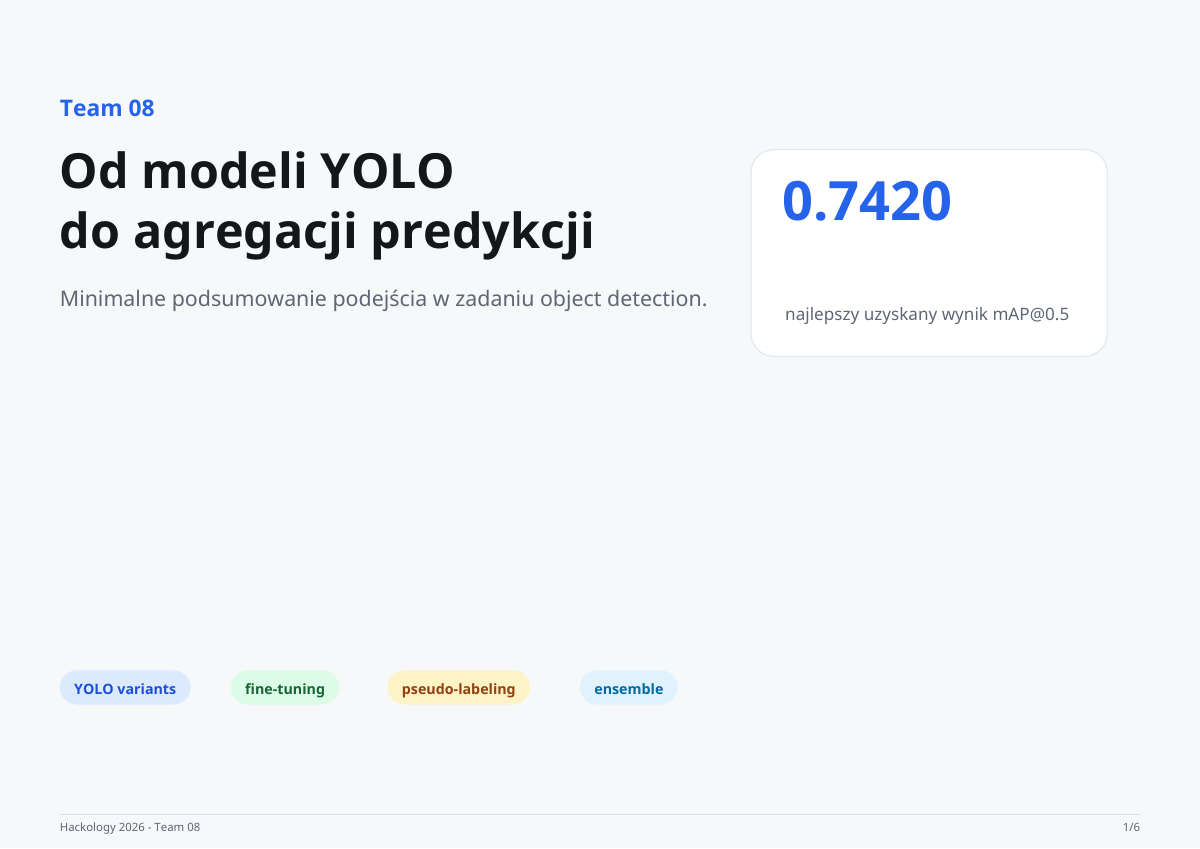
The team experimented with individual YOLO models, inference resolutions, fine-tuning and pseudo-labeling. The final solution combines five prediction sources from four unique model weights, using test-time augmentation and Weighted Box Fusion.
Two sources use the same weights at different resolutions. Stronger prediction sources receive a larger weight in the ensemble.
Reported results
| Metric | Result | Scope |
|---|---|---|
| Public [email protected] | 0.7420 | Public evaluation reported in the presentation |
| Validation [email protected] | 0.8528 | Local holdout reported in the detailed slides and repository |
| Prediction sources | 5 | Four unique weights, with one evaluated at two resolutions |
Public and validation results come from different datasets and should be read separately.
What the experiments showed
More sources did not automatically improve the public result. An eight-source ensemble improved validation performance but performed worse on the public set. The selected five-source setup balanced complementary models and false positives.
Dense shelves and visually similar variants remained difficult. The detailed slides identify tiled inference, confidence calibration and a two-stage detection/classification approach as possible follow-up work.
Source: Team 08 presentation, detailed slide notes and project repository.